


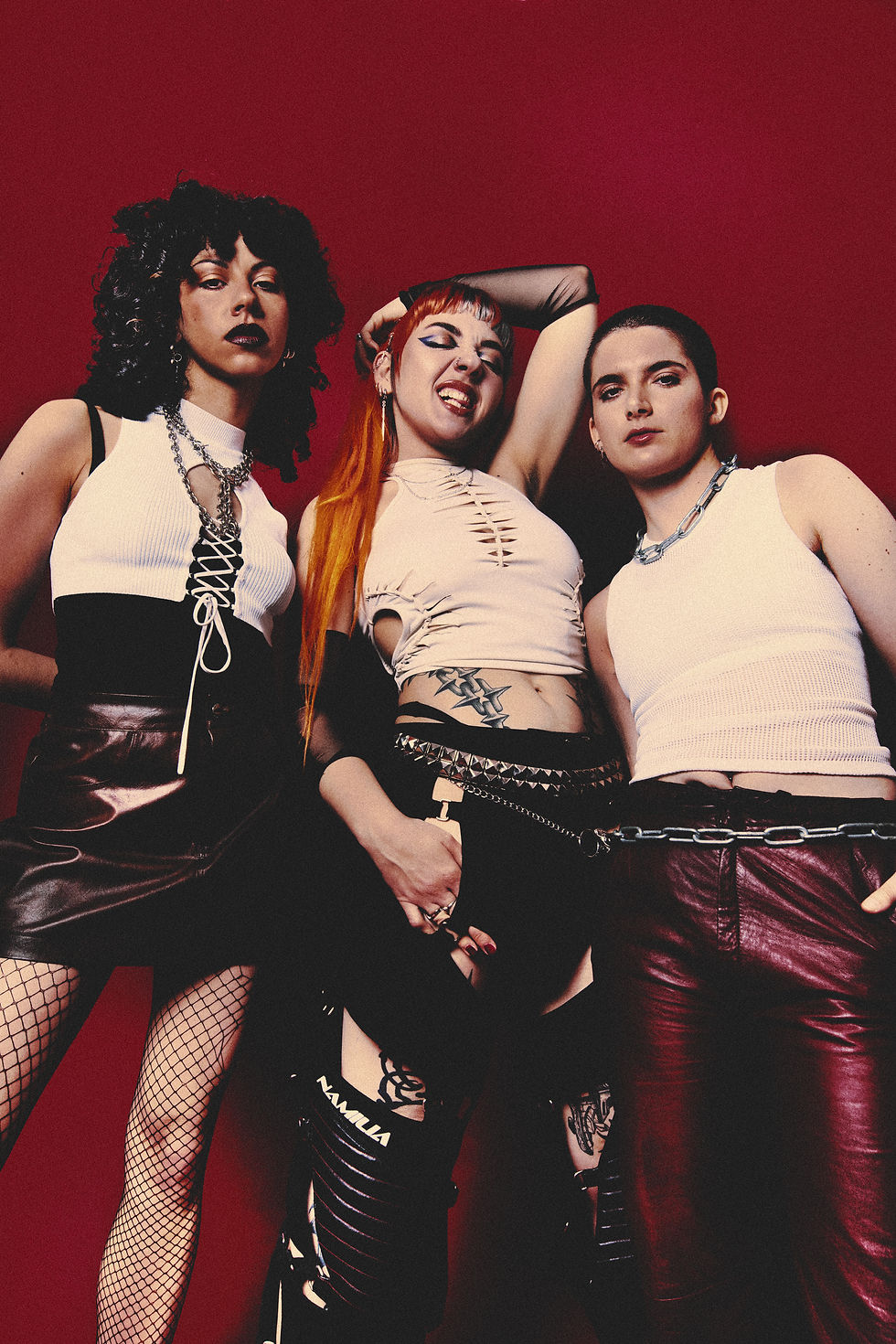
Grandma's Ashes : With "Bruxism," we broke down our personal barriers.


NOIRE: Hello Eva, Myriam, and Edith! There are three of you—could each of you introduce yourself in three words?
EDITH : Hi, I’m the drummer for Grandma’s Ashes, and I also sing backing vocals from behind the kit!
EVA : Hi, I'm Eva, lead singer and bassist for Grandma's Ashes; I'm also a tattoo artist and the illustrator for the merch we offer.
MYRIAM : Hi, I’m Myriam, the guitarist for Grandma’s Ashes; I also do backing vocals.

NOIRE: You started composing as Grandma's Ashes in 2021. Was this your first band? When did each of you begin your musical career?
EDITH : I was in a few bands before; when I started playing drums at 13, I formed a group with my best friends—we were all really into AC/DC, Green Day, System... We played together until the end of high school. After moving to Paris for my studies, I was in a few lineups that never really made it out of the rehearsal room, and then I met the girls—we’ll be celebrating the band’s 10th anniversary next January! EVA : I started composing at a very young age; I was raised by musician parents, so I had access to the wonderful world of living-room rehearsals and instruments in every room from the time I was tiny. I began playing my own compositions in high school with my first bands, and after a few gigs and various lineups, I met Myriam, and later Edith—and here we are! At first, we played a set of my songs, but then we started writing new material—first as a duo, then as a trio—which has now resulted in an EP and two albums.
MYRIAM : I started playing music as a teenager, joining various bands at high school with my best friends. We were heavily into glam rock and hard rock—bands like Guns N’ Roses, Mötley Crüe, Led Zeppelin, T. Rex, and QOTSA. I cut my teeth in an early band—leaning towards garage and heavy psych, where I discovered guitar effects like fuzz and delay and wrote my first songs.
When I arrived in Paris, I immediately met Eva, who already had about twenty songs written; we hit it off right away. We started rehearsing together and blending our musical worlds—ultimately, it was our shared love of 90s culture and prog rock that brought us together, leading us to form Grandma’s Ashes.
NOIRE : Since then, you have released an EP titled The Fates a debut album called This Too Shall Pass and, of course, your new record Bruxism, released on Veryrecords on October 24, 2025. What did you aim to express in each of these compositions, and what do they have in common?
EDITH : With the first EP, the three of us got to know each other musically; those were our first original tracks—heavily influenced by stoner rock, with a few progressive touches. We were already drawing on personal experiences in the lyrics, though there was still a certain reticence, masked by dark humor.
We opened up more on the first album, This Too Shall Pass, which was composed during lockdown between long introspective sessions over tea, talking about our lives, our fears, our doubts. It's much more lyrical and progressive.
And the latest, Bruxism, was created with the desire to break down our personal barriers and turn the scene upside down. We made more room for the anger and violence we feel every day, but I would say that all three are a journey into our sensibilities.
EVA : As with our previous two albums/EPs, we focus primarily on ourselves—our personal experiences and emotions—and also touch upon mental health. The themes are at once deeply personal and universal: depression, anxiety, and sadness. The key difference is that we’re hiding less behind metaphors; we’re more direct. We’ve realized that this vulnerability brings us closer to our audience, so we’ve made ourselves even more accessible—both in our lyrics and our songwriting—to share what we have to say more fluidly.
NOIRE : Bruxism touches on numerous themes, such as eco-feminism, stress, and mental health. What drove you to highlight these themes, which are deeply rooted in today's society?
EDITH : It all started with observations from our daily lives in Paris: long minutes spent packed into the metro during rush hour, the shoving, the unpleasant remarks, people’s aggression, and the indifference we unconsciously develop over the years. We felt like we were losing a part of our humanity, like we were being ground down; music became a way to express that anger.
EVA : As with the previous question, there was a need—an urgent desire—to communicate and share, and to feel less alone in dealing with themes that resonate with so many people in our audience. We wanted to create an album rooted in the present day, and to be grounded in our own bodies and minds—both while composing and when performing on stage.
NOIRE : Can you tell us about the creative process behind *Bruxism*?
EDITH : For Bruxism, we kept jamming just as we had for the EP and the first album: the three of us would get together to make demos, listen to old audio clips saved on our shared drive, and play until song structures began to take shape.
We also worked on Ableton individually; I would program drum parts to test out different versions and come up with ideas that might not have occurred to me while sitting behind the actual drum kit.
Eva and Myriam were also experimenting at home with song structures and sounds. That’s how we arrived at the more electronic elements on the album—such as the vocal processing on Neutral Life Neutral Death or the use of drum machines.
EVA : For my part, I was experimenting with a synthesizer—partly to alter my voice, but also to add textures or little melodic ad-libs that responded to the effects Myriam was using on her pedals during the demo phase. We didn't rule out any kind of experimentation.
I was also taking lessons in both classical and distorted vocal techniques to broaden my vocal range; ultimately, working remotely gave me the space—free from self-consciousness—to explore new vocal possibilities as well.
It can be a bit intimidating to try things out vocally in front of other people, so the back-and-forth between the computer and rehearsals really fostered a gentle, low-pressure environment for experimentation.

NOIRE : What are your musical influences—for the three of you—and which ones inspired you the most in creating this album?
EDITH : I’ve always been really inspired by Deftones—and by drummer Abe Cunningham’s playing; the three of us are huge fans. There’s also Paramore, Nine Inch Nails’ live shows, and post-metal bands like Amenra and Cult of Luna…
EVA : For this album, I revisited many of my teenage influences. Grunge and nu-metal first—bands like Kittie, Limp Bizkit, Korn, Alice in Chains, and Coal Chamber—which inspired me to incorporate more distortion and punchiness into both the vocals and the bass riffs (particularly on Flesh Cage).
I also really tapped back into my New Wave phase; I wanted to recapture the freshness and melancholy found in the sonic experiments of certain The Cure albums (like The Top).
At the same time, I was diving headfirst into electro- and pop-influenced music—Sneaker Pimps, Addison Rae, Yellow Magic Orchestra. I wanted to bring in more modern, hyper-pop sounds.
MYRIAM : I think our strength lies in the diversity of our influences. When composing *Bruxism*, I listened to a lot of trip-hop (Massive Attack, Sneaker Pimps) and Nine Inch Nails, but also to more electronic and ambient projects like Boards of Canada.
I wanted to return to a rawer guitar style—listening to Korn and Deftones—and I think Wes Borland was a major influence regarding textures and effective riffs; however, I also listen to a lot of folk and indie (Nick Drake, Elliott Smith), which comes through in quieter tracks like Dormant or Calix where I use fingerpicking techniques. It’s quite a mix!
NOIRE: What would you say to your past self from five years ago, at the very beginning of your career?
EDITH : I'll tell him to take things a bit more lightly and not forget to have a blast!
MYRIAM : Likewise, I would tell her that the most important thing is to enjoy the present moment, to persevere, and to be proud of what one is fortunate enough to accomplish.
EVA : I would say: let go, and enjoy the joy of the moments on stage.

NOIRE: You will be performing at the opening of Tout n'est pas Sombre—an art exhibition centered on metal and death—taking place in Rochefort from September 19, 2026, to January 2, 2026. I’m curious: who are your favorite visual artists?
MYRIAM : I really love Eliran Kantor’s paintings. His work draws on the conventions of *chiaroscuro* and blends mythology, esotericism, and dark imagery. It is an aesthetic very close to the one we chose for our debut album—and, more broadly, to an iconography deeply rooted in metal culture.
Beyond the music, many bands bring their worlds to life through costumes, set design, or stagecraft, creating an almost ritualistic experience. It is a way of exploring darkness while revealing the beauty that can lie hidden within it; that is what metal is all about.
I also greatly appreciate Ester Segarra’s photography. Her images exude great intensity and perfectly capture that theatrical, immersive dimension, where the visual element plays just as much of a role as the music in telling a story.
EVA : I’ve been watching a lot of animation lately, and I have to admit I’m still reeling from the sheer impact of the film Belladonna of Sadness. The clear Art Nouveau influences, along with stylistic nods to the illustrations of Aubrey Beardsley and Harry Clarke, are a huge source of inspiration for me. It is visually dense—Baroque, dreamlike, and very dark.
I’ve also discovered the work of Daniele Castellano; it reminds me of Hieronymus Bosch, but even more unsettling—modern, colorful, and acid-toned. Within that same circle of illustrators—and throughout my career as a tattoo artist—I’ve frequently encountered the work of Lou Benesch; her pieces inspire me daily with their poetic quality and surreal subject matter.
NOIRE: What are your future plans?
EDITH : We’re still fully immersed in the tour; all these dates are sparking new ideas, and we can’t wait to see what emerges after so many months without jamming together. For now, we’re really focused on live shows—with some great dates this summer, notably Rock en Seine—but we’ll ease back into writing once things quiet down a bit.
Merci à Myriam, Edith et Eva pour cette interview, à l'Agglomération de Rochefort pour l'idée et à Angie de NRV Promotion pour la mise en relation !


Comments