


Haprefleur "Contemplating plant and animal life is an important part of my writing."


NOIRE: Hello Lotus Pâle, could you introduce yourself briefly?
Lotus Pâle: Hello to you and the readers of Noire. Thank you for this interview. I am Lotus Pâle, a musician from Périgord Pourpre, and the mastermind and sole member of Haprefleur.
NOIRE : You are introducing me to Haprefleur today. What inspired you to create this solo project?
Lotus Pâle: The idea for Haprefleur took shape in 2022, born of a desire to create a black metal project that would pay tribute to the old French scene and its more atmospheric fringes specifically Aäkon Këëtrëh and the 1996 demo Dans la forêt, which served as the starting point for my vision.
The guitar sound and the atmosphere it evoked resonated deeply with me. Although my own sound differs, the sonic treatment of the track Forêt (Partie I) is heavily influenced by that approach. Above all, I wanted to create a somewhat obscure, forest-inspired project; it finally came to life in early 2024.
NOIRE : While black metal often draws inspiration from flora and fauna, Haprefleur explores this theme in a different way. At first glance, one might sense delicate qualities, yet the music transforms into a brutal manifestation of wild nature, channeled through your tortured screams. What story did you want to tell through this project?
Lotus Pâle: Nature is wonderful in itself, yet it is also capable of great violence. I try to capture this duality in my music.
I primarily draw upon the thoughts that cross my mind during walks in the forest or amidst rural landscapes, specifically fields of wheat, corn, or other grains. All of this evokes a wide range of feelings and reflections. However, being a deeply nostalgic person, I often find myself returning to memories, most frequently, those involving family.
Contemplating plant and animal life also plays a significant role in my lyrics. For instance, the lyrics to Haprefleur simply describe one of the rosebushes in my mother’s garden.

NOIRE : You say you are strongly inspired by Gustave Doré, Eugène Carrière, and Paul Verlaine. How has the work of each of these artists blended into your compositions? What has each of them contributed to your work?
Lotus Pâle: Gustave Doré has been a part of my imagination since childhood. When I was young, I had a book of La Fontaine’s Fables illustrated by him, and his illustrations fascinated me. When I was looking for cover art for my first EP, he was the first person who came to mind. His engraving The Forest and the Woodcutter ended up defining the aesthetic of my early work.
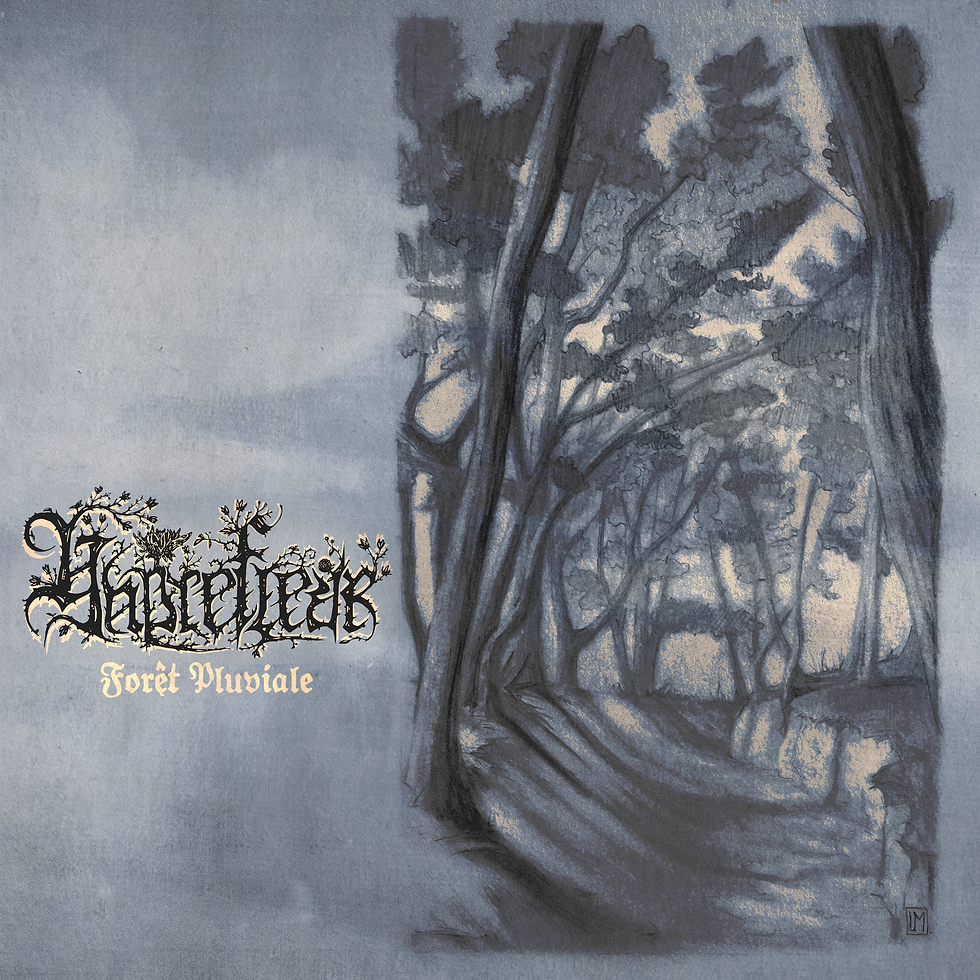
I discovered the painter Eugène Carrière a few months before writing *Pluvial*, during a weekend trip to Amsterdam where I visited the Van Gogh Museum. His work immediately resonated with me, particularly the misty, haunting quality of his paintings. This discovery had a significant influence on the composition of this release.
The artwork provides a framework for my music, and I then try to translate that world into my compositions as faithfully as possible.
Verlaine was a different story. I was looking for a poem to set to music, and "Un dahlia" quickly came to mind. The floral theme, linked to femininity, really spoke to me. The poem’s melancholy naturally led me toward a more "post-black metal" style of composition.
NOIRE : These artists share a strong connection to atmosphere, light, materiality, or landscape. Are these concepts that you also seek to convey musically?
Lotus Pâle: Absolutely. Musically, I aim to evoke these feelings through the ambient pads found on certain tracks, as well as the rain samples that permeate almost every song.
Reverb, which is also prominent in the mix, plays a major role in creating this atmosphere, as does the "cold" quality that defines the overall sound. That is what allows me to establish the world I am trying to portray.
NOIRE: What was the creative process behind the tracks rearranged for the *Forêt Pluviale* compilation, released last August?
Lotus Pâle: As for the tracks that had already appeared on my previous releases, my main goal was to breathe new life into them with better production and a more effective sound. It involved a great deal of listening and rearranging based on the original tracks in Logic Pro. I reworked almost all the drum parts, as I felt they didn't always sound quite right in the original versions.
I think the track Le Dahlia benefited the most from this reworking. The whole process took a few months, time to revisit the various tracks and achieve a result I was happy with before officially launching the compilation project.

NOIRE: This project was recorded in various locations, from Périgord Pourpre to Burgundy. Did these places directly influence your music?
Lotus Pâle: I am simply a product of my environment! In reality, only *Tournesol* and *Perce-Neige* were composed in Burgundy. Since the landscapes there struck me as less spectacular, I found less of that contemplative quality, giving way instead to something more introspective.
These tracks are therefore quite different from my previous releases, featuring a rawer, more rock-oriented approach. To give you an example of my desire to capture my surroundings: when I was in the Périgord region, I even sampled the rooster from my garden. You can actually hear him in Forêt II (2nd version)*, his name is Cupidon II.
NOIRE: What are your future plans for Haprefleur?
Lotus Pâle: Right now, I’m working on the physical release of the compilation. Once that’s out and shipped, the next step will be to compose the album, prepare a great release for it, and why not? Take it out on the road. As for what comes after that, time will tell!
Thanks to Lotus Pâle for answering my questions :)


Comments