


Giancarlo Melgar - When dark art meets metal music


NOIRE: Hi Giancarlo, could you introduce yourself to our readers?
GIANCARLO : Hello, everyone! My name is Giancarlo Melgar, and I’m a Peruvian visual artist and musician. I was born in the southern region of my country, in a province called Arequipa, and I currently live in Lima.
I hold a bachelor’s degree in visual arts from the National Autonomous University of Fine Arts of Peru and a technical degree in graphic design. Currently, in addition to showcasing my work at various cultural venues, I work as an illustrator with national and international bands, creating a variety of commissioned pieces such as album covers, merchandise, flyers, and more. I’ve had the honor of collaborating with bands such as Foetorem (Denmark), Inerth (Spain), CrusHuman (USA), Algebra (Switzerland), Ocean Throne (Finland) or Crimena Bathory (Peru), just to mention a few.
Since 2004, I have been collaborating as a vocalist with bands such as Tefrosis, Craneotomy, Avoidant, Earthwomb, and Aliaga—projects associated with genres like death metal, black metal, and grindcore.
NOIRE: What inspired you to become an artist?
GIANCARLO: Although it may seem a little strange, my first encounter with the visual arts wasn’t through an exhibition or a specific work of art that made an impression on me. On the contrary, music has been a source of creative inspiration for as long as I can remember, because I was always very attentive to album covers and music videos.
When I was a kid, we listened to a lot of progressive rock at home, so I was constantly exposed to incredible artwork by bands like Yes, Genesis, Camel, King Crimson, and Pink Floyd, but one of the album covers that made the biggest impression on me was Emerson, Lake & Palmer’s Brain Salad Surgery (1973), designed by the great H. R. Giger. I also remember that the animation in Pink Floyd’s film The Wall had a profound impact on me during that stage of my life, especially the sequences used for the tracks Goodbye Blue Sky and Empty Spaces.
Later, through skateboarding, friends, and family, I learned a bit more about hardcore, metal, post- rock, noise, ambient and other genres, and I gradually expanded my aesthetic and artistic horizons.
Strangely, my earliest drawings were scenes or comics of concerts or musicians, and it wasn’t until a few years later in high school—or before college—that I began to examine more closely certain art movements that resonated with me, such as Expressionism and Romanticism. During my time as a visual arts student, I was also very interested in other types of artistic creation away from painting or drawing, such as sound art, video art, performance, installation, and others more related to conceptual art/contemporary art.

NOIRE : You paint dark universes and figures, often using the chiaroscuro technique. What do you aim to express through your artworks?
GIANCARLO: I believe my approach to my work has evolved to highlight, so to speak, the different themes or concepts I’ve explored in each artistic project I’ve worked on over the past few years.
My most recent exhibition projects have focused on exploring the different dimensions and contingencies that can be found within such broad concepts as landscape and time. But I like the idea of having a dark surface that allows me to create the sensation of an image emerging from the depths of a void or opening a kind of portal in the middle of a drawing.
These kinds of visual effects are achieved through the contrasts produced by the strokes of white pencils. It is through this action (which may seem simple) that I have, in that brief fraction of time during my creative process, the opportunity to sculpt light and darkness.
I also believe that even though my style may seem somber, dark, or melancholic, it’s a bit reductive to view it from that perspective. I don’t just seek to stay within those limits, and I feel that my visual approach can have a much more expansive and ethereal interpretation, one that seeks to explore, across the board, the various concerns I can express through each work.
NOIRE : You're a musician, graphic designer, and visual artist. How do these different disciplines intertwine in your everyday life?
GIANCARLO: All three are extremely complicated careers to pursue today in a world that is constantly changingthe rules of the game we knew every second, due to the implementation of AI in our lives.
However, I believe that after many years of trial and error, I have managed to establish a workflow methodology that allows these different areas of knowledge to interact and be applied to my work as an illustrator. This ranges from understanding the recurring aesthetics of certain genres because I consume them regularly, to immersing myself in the design work as if it were for one of my own bands, and understanding the financial challenges of each DIY project so I can offer various alternatives to support them and bring the collaboration to fruition. These are all things I experienced firsthand back when I was much more active as a vocalist.
This background has allowed me to build much closer connections with my clients, primarily because I know from personal experience the different facets and processes involved in creating an album, EP, demo, or single.
All of this has led to conversations with several of my clients that, in many cases, go beyond the purely artistic. We don't just interact to review deliverables for each commission; they have even asked for my opinions or input on their lyrics or compositions. For me, this kind of dynamic is an absolute honor, as I’ve had the opportunity to work with highly talented individuals who are humble enough to value feedback coming from me.

NOIRE : What are the main influences behind your artwork? I imagine that H. R. Giger is one of them— am I right?
GIANCARLO: H.R. Giger is definitely one of them. When I started to become more interested in painting, I discovered the work of Francis Bacon, and I always go back to his work; I find something new with each viewing. I think there's a lot of his influence on my work, mainly in the textures of the bodies or faces of some of the figures, which seem to distort until they're completely deformed.
Toshihiro Egawa is also a visual artist I deeply admire, and I hope to reach his level of drawing
someday. I find his monochromatic work incredible, but actually, all his work is outstanding. I
discovered him because he designed the album covers for my favorite bands, Internal Suffering and Deeds of Flesh.
Zdzisław Beksiński is another artist I discovered through friends during my time at university. His work is timeless, and I have always found his dark concept of architecture, or the creation of structures by mixing deformed organic body parts and elements in symbiosis with concrete, stones, metals, or other materials, very interesting.
Masahiro Ito, the artist in charge of art direction and creature design for one of my favorite video games, Silent Hill. I grew up watching the evolution of this franchise from a young age, and it has definitely had a major influence on my work.
Other artists who also resonate with me include José Gabriel Alegría Sabogal, Eva Jospin, Daniel de la Barra, Wendelin Wohlgemuth, Elena Damiani, Alejandro Jaime, Anna Park and Jorge Corpuna, just to name a few.

NOIRE : What is the creative process behind your paintings? How do they come to life?
GIANCARLO: To be completely honest, it’s entirely unpredictable. When it comes to how ideas spark in my mind, a conversation, a song lyric, a movie quote, a sound, or a fragment of a poem or text can often trigger images that I instantly want to capture. Sometimes the most unexpected or mundane things can be the best catalysts. Even when you are doing things completely unrelated to your art practice—like walking, cooking, washing dishes, or simply being in silence—it subconsciously helps clear your mind and opens the door for new ideas to flow in.
Regarding my technique, that is also highly variable. I tend not to make many sketches when I'm creating pieces for personal projects; I prefer to dive straight into the "blank canvas." Often, this workflow operates beautifully: from just a few lines or smudges, an image gradually emerges until it aligns with what I had in mind. However, things can also go completely wrong working that way— turning into absolute chaos or leaving me stuck mid-process. When that happens, I usually end up leaving the piece unfinished or tossing it in the trash to start over from scratch using a different strategy.
On the other hand, I do work with preliminary sketches, primarily when handling commissions for clients who need cover art for a release, merch, logos, or flyers. In those cases, I need to provide them with a rough sketch so they can approve it or suggest changes before I begin developing the final piece.


NOIRE: Your work is often used by metal bands for album covers. Can you tell us about the first time a band approached you for a collaboration?
GIANCARLO: I remember working with a few local bands many years ago, around 2008–2009, a time when a vibrant new scene of modern death metal, deathcore, metalcore, slam, and their subgenres was gaining massive momentum in Peru. To be honest, back then, both my technical skills and my visual style were quite limited. They were symbolic collaborations done to support the bands; I enjoyed it immensely, but at that point in my life, I wasn't working professionally like I do now.
However, I also remember with deep gratitude my first international collaborations between 2022 and 2023. During that time, I had the opportunity to design logos for Hoofmark (Portugal) and Howls of Derision (Ireland), the cover art for the album Ostara by Taagefanger (Denmark), and a T-shirt design for Naire (Austria).
Those were years of intense learning for me in every sense—from gradually developing a proper workflow with each new commission, to optimizing my turnaround times and working more effectively according to the specific requirements of each design, since every commission is entirely unique and comes with its own set of complexities. Looking back, I think that in some cases, the challenges arose from my purely traditional approach to art. While this adds unique value to each piece, it also brings its own challenges when it comes to processing, digitizing, and editing every image in a distinct way.
I made plenty of mistakes along the way, but I was fortunate enough to work with clients who were incredibly respectful, patient, and kind. That played a huge role in making this entire learning experience truly enriching in every aspect.

NOIRE: What I particularly like about many of your black-and-grey paintings is that they often resemble fractals or intricate repeating patterns, almost like labyrinths. Are you inspired by mazes? And what do they represent to you?
GIANCARLO: Your perspective is very intriguing; I don’t think I had ever looked at that particular aspect of my artwork in that way. Yet, I believe it is not far from what I aim for. My visual approach does not seek to mimic reality; instead, each image carries an ethereal or spectral weight that distorts or blurs its structure—in some cases, to the point of rendering it unrecognizable.
This is perhaps why you consistently see faces, bodies, or landscape elements that seem to split open, revealing fibers, particles, and ligaments. However, this does not stem from a gore aesthetic; the approach is far more metaphysical and symbolic. It is about symbolically tearing through surfaces through the act of drawing, revealing the distinct processes operating within—processes that manifest as psychosomatic degradation, transmutations, embodiment, dematerialization, or energetic decay.

NOIRE: What are you currently working on? GIANCARLO: Right now, I’m taking a bit of a break from drawing and painting—an active pause, you could say, because I’m still creating, just not as intensely. I’ve had a pretty hectic few months with two back- to-back solo exhibitions and a few group shows. I’ve been creating almost non-stop since the beginning of the year, so I was definitely due for a few days off.
But it won’t be for long. I need to start preparing new pieces for upcoming exhibitions; I’d love to work on a series of large-scale drawings, and I hope to make some progress on that during the remainder of the year or early 2027.
At the same time, I’m developing cover art and merchandise for a few international bands on my schedule, and I hope to share the final results of those collaborations very soon.
I’m also in talks with other creators from different disciplines to develop collaborative projects. I don't have anything concrete to share just yet, but everything is looking incredibly interesting.
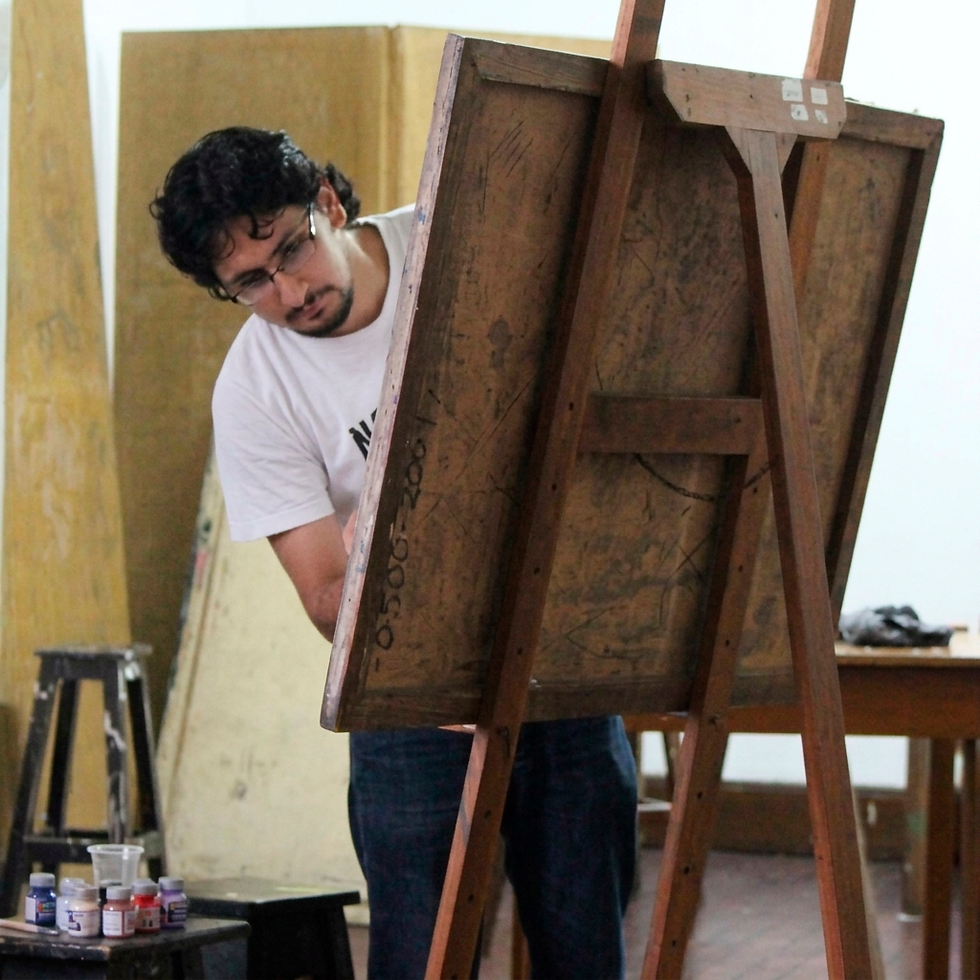
NOIRE: When will your next exhibition take place? And do you have any plans to come to France in the near future? GIANCARLO: I will be presenting a few pieces in a few days at a group exhibition taking place on July 3rd in Lima. I also have another group show lined up for late August, as well as the possibility of doing a duo exhibition with a female artist from Lima in northern Peru. We still need to finalize a few details, but I am very excited about the prospect of showcasing my art in new spaces and connecting with an audience that hasn't had the chance to see my work before.
I don't have plans to visit France or exhibit there just yet, though I do have family living in Paris and would love to see them. However, I hope to put together a solo or group exhibition there sometime in the future.
Currently, I am coordinating my first international solo show. I hope everything goes smoothly regarding dates and logistics with the venue hosting my work so I can announce it soon. I am truly thrilled about this opportunity, and I hope it all turns out great!
Thank you so much for this interview, Cécile. I really enjoyed answering each of your questions.
NOIRE: Thank you, Giancarlo, it was really fascinating to dive into your universe again!


Comments